
July 2026: SOCPacific2R at ICRS – A Pacific-wide team brings reef passages and keystone places to Auckland
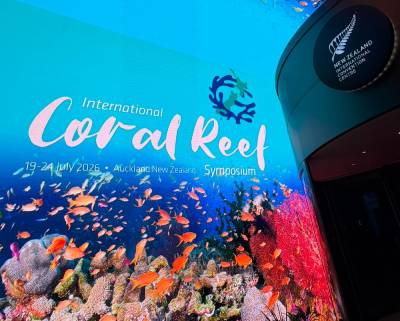
The 16th International Coral Reef Symposium (#ICRS2026) brought together over 2,000 coral reef scientists, managers and practitioners from more than 90 countries in Auckland, Aotearoa New Zealand, from 19–24 July 2026. Across that week, people from SOCPacific2R — our Fijian, French and German teams, our advisory group and our student interns — showed up in force, carrying the project’s core question into rooms across the venue: what makes a place or a species matter enough, socially and ecologically, that communities organise their conservation around it?
The centrepiece was our own special session on Social-Ecological Keystone Places and Species (SEKPS), extending the ecological idea of a “keystone species” to the culturally and socially vital places and species that anchor Indigenous-led reef conservation. Ten speakers across two 90-minute slots took the concept from Malaysia’s Tun Mustapha Park to Mayotte and Madagascar, French Polynesia, Hawaiʻi, Australia, Fiji and New Caledonia. Among them was Devavrat Bishwa on reef passages and trevally as keystone places and species, including his and his fellow students’ (Matina Kaitapu, Sarah-Fina Manulevu and Watesoni Nata) transdisciplinary research, Salanieta Kitolelei and Jokim Kitolelei on Fijian fishers’ perceptions of reefs as keystone spaces and coral boundaries as ecological frontiers in Fijian community-led conservation, Anuata Tetuanui on the Rāhui, and Catherine Sabinot on totemic and ancestor species as tools for transformative governance.
The reach went wider still. A USP Centre for Sustainable Futures delegation — Amanda Ford, Brian Stockwell, Jasha Dehm, Salanieta Kitolelei and Jokim Kitolelei, alongside graduate students including Devavrat Bishwa — had its participation supported in part by SOCPacific2R, presenting on everything from microplastics in Pacific fisheries to AI-assisted reef monitoring, and co-hosting a side event on coordinating coral reef monitoring across the Pacific Islands with SPREP and AIMS.
A huge thank you to everyone who presented, co-authored, organised and showed up — students and senior scientists alike — for representing SOCPacific2R and its partners so well on this global stage, and for keeping Indigenous- and locally-led, community-grounded reef conservation firmly in the conversation at ICRS2026.